REST vs SOAP vs GraphQL: What Wins for Integrations in 2025?
A senior-architect framework for choosing REST, SOAP, or GraphQL in 2025—plus where GraphQL fits best as an API aggregation layer, common anti-patterns, and performance/observability traps.
Written by Artemii Karkusha — Integration Architect
REST vs SOAP vs GraphQL — Which Integration Protocol Wins in 2025?
The Problem
A common failure pattern we see in real-world integrations looks like this:
A B2B customer portal needed 9 REST calls just to render a single product page: product → pricing → contract rules → warehouse availability → customer credit status → CMS content.
On paper, each API responded in 80–150 ms. But combined latency, network overhead, and lack of caching pushed total page load time to 5.2 seconds.
After refactoring the flow into a single GraphQL aggregation query, the same page rendered in 620 ms under normal load and stayed under 900 ms during peak traffic.
Sales teams reported a 22% drop in cart abandonment within two weeks.
Nothing was technically “broken” — the architecture was.
In 2025, many integration teams still struggle with a fundamental question during system design: which protocol should we choose — REST, SOAP, or GraphQL?
ERP teams often push for SOAP because "that's how SAP works". Modern frontends demand GraphQL. Your eCommerce system exposes REST. And somewhere in the middle, the integration layer becomes a battlefield of mismatched expectations, performance bottlenecks, and maintenance nightmares.
If you choose the wrong protocol at the wrong boundary, the entire integration stack becomes fragile.
Why This Happens
Most teams select a protocol based on habit, not architecture principles:
- "Magento uses REST — let's continue with REST everywhere"
- "SAP exposes SOAP — let's build SOAP-to-SOAP pass-throughs"
- "GraphQL solves everything — let's replace REST!"
But each protocol solves a different problem. Choosing the right one requires understanding:
- payload shape control
- real-time vs batch needs
- API evolution requirements
- performance constraints in integration-heavy systems
Let's break down each one.
REST — The Workhorse of Integrations
Best for: CRUD operations, predictable resources, eCommerce, ERP connectors, microservices
REST wins when:
- You need clear resource boundaries (orders, products, customers)
- You need caching
- You want stable long-term APIs
- Your integration layer must handle millions of requests/day
Strengths
- Simple and widely adopted
- Cache-friendly (CDN, reverse proxies, Redis)
- Great for "read-heavy" operations
- Easy to scale horizontally
Weaknesses
- Over-fetching (common in mobile and frontend-heavy apps)
- Under-fetching (multiple calls to build a single response)
- Harder versioning when models grow
Real Example
Adobe Commerce, Shopify, Salesforce Commerce Cloud, Akeneo, and most modern ERPs expose REST endpoints for the majority of integration tasks.
SOAP — The Dinosaur That Refuses to Die (For Good Reason)
Best for: ERP-to-ERP integrations, financial systems, legacy enterprise apps, strongly-typed contracts
SOAP survives because:
- It enforces strict schemas
- Enterprises need guaranteed structure and formal contracts
- It’s heavily used in SAP, Oracle, Epicor, NetSuite
Strengths
- Strong typing (XSD)
- Built-in WS-Security, encryption, signing
- Excellent for transactional integrity (think: payments, invoicing)
Weaknesses
- Heavy, verbose XML payloads
- Harder to debug
- Slow to evolve
- Not ideal for mobile or high-frequency integrations
Real Example
SAP’s BAPI and many FI/CO processes still rely on SOAP, and replacing them is unrealistic for most enterprises.
GraphQL — The New Standard for High-Flexibility APIs
Best for: frontends, custom dashboards, mobile apps, dynamic integrations needing flexibility
GraphQL shines when:
- You need absolute control over payload shape
- You want to avoid multiple REST calls
- You need fast product-, price-, or catalog-heavy interfaces
Strengths
- Zero over-fetching
- Zero under-fetching
- Excellent for complex joins
- Self-documented schema
Weaknesses
- Not cache-friendly by default
- Complexity increases quickly
- Requires strict governance to avoid performance disasters
Real Example
Shopify Storefront API, Magento 2 GraphQL, and most modern headless solutions rely heavily on GraphQL.
Where GraphQL Fits Best in System Integrations
API Aggregation (the “Composition Layer”)
GraphQL becomes incredibly powerful when your consumer (frontend, partner portal, mobile app) needs data that normally requires calling 3–8 downstream services — e.g., ERP + PIM + pricing + inventory + CMS.
As a Backend-for-Frontend (BFF) or API Gateway, GraphQL can:
- Combine multiple downstream REST/SOAP calls into one query
- Return exactly the fields requested
- Remove the need for creating dozens of custom REST endpoints
Key wins
- One round-trip instead of many → huge latency reduction
- Flexible data models — clients decide the shape
- Schema as a contract with introspection
- Faster iteration — UI teams ship features without backend changes
Big watch-outs
-
You are now building an orchestration layer:
- timeouts, retries, fallbacks
- preventing cascading failures
- handling partial results
- If you don’t control query depth/complexity, one clever partner can melt your ERP
Diagram — Where REST, SOAP, and GraphQL Belong in a Modern Integration Architecture
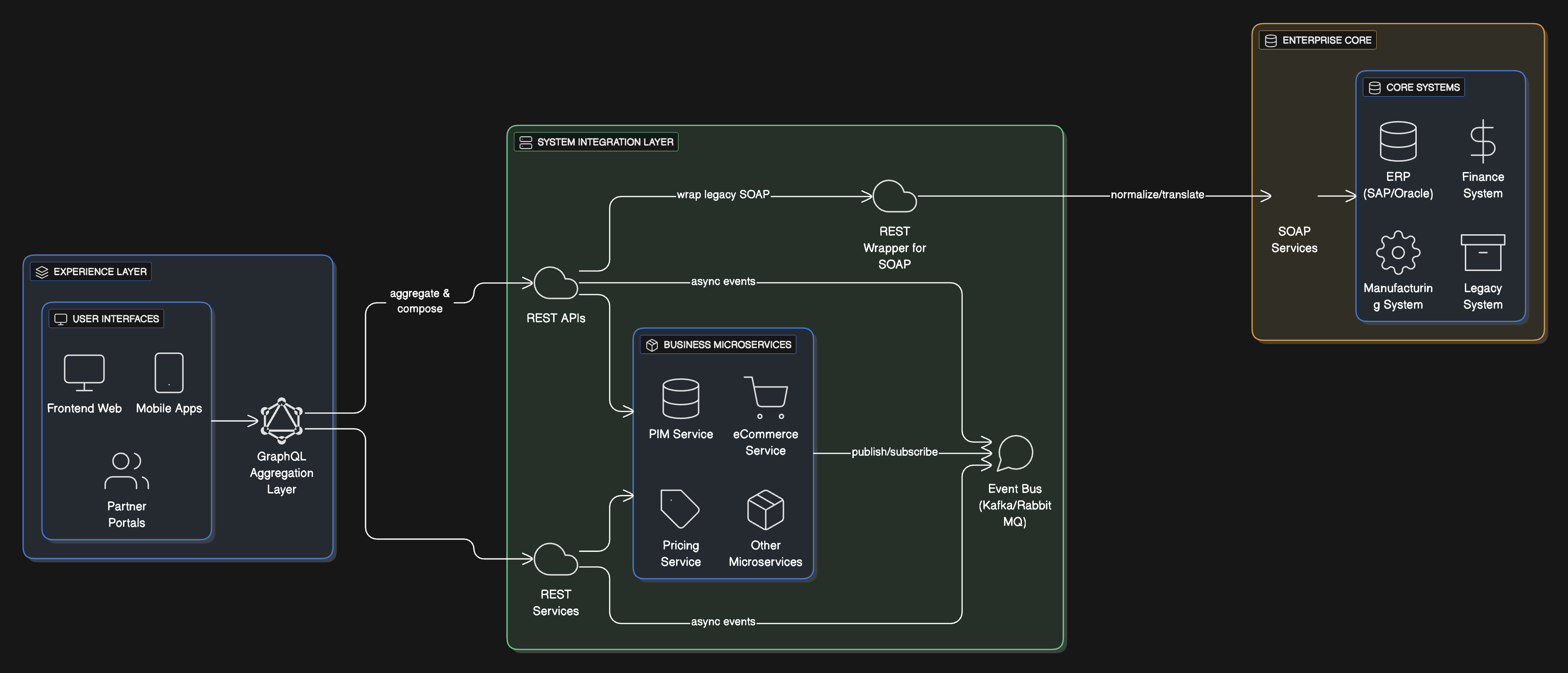
How to read this diagram:
- GraphQL sits at the top, closest to the consumer, aggregating multiple data sources.
- REST handles most system-to-system interactions, acting as wrappers, microservices, and outward-facing APIs.
- SOAP stays deep in the enterprise layer, never exposed directly to modern consumers.
Comparison Table — REST vs SOAP vs GraphQL (2025)
| Criterion | REST | SOAP | GraphQL |
|---|---|---|---|
| Best Use Case | System boundaries, CRUD, integrations | ERP, finance, strongly-typed contracts | API aggregation, UI data needs |
| Flexibility | Medium | Low | Very high |
| Performance | High (cache-friendly) | Low–Medium | High, but depends on query complexity |
| Payload Control | Limited | Fixed | Full control (client-defined) |
| Security | Varies by design | Very strong (WS-Security) | Good but must be governed |
| Versioning | Medium difficulty | Heavy, slow | Easy via schema evolution |
| Best for Writes | ✔️ | ✔️ (transactional) | ⚠️ Not ideal |
| Best for Reads | ✔️ | ❌ | ✔️✔️ (excellent) |
| Common Platforms | Shopify, Magento, Akeneo, custom APIs | SAP, Oracle, Infor | Shopify Storefront, headless UIs, BFF layers |
Common Integration Anti-Patterns
- ❌ GraphQL calling ERP directly — leads to massive performance issues and brittle schemas.
- ❌ Passing SOAP payloads through REST unchanged — breaks abstraction layers.
- ❌ Using SOAP for modern microservices — heavy, slow, inflexible.
- ❌ Putting business logic inside GraphQL resolvers — turns BFF into a monolith.
- ❌ No GraphQL query governance — single queries can overwhelm downstream systems.
Protocol Selection Checklist
Use this checklist to choose the correct protocol instantly:
- Does the consumer define the data shape? → GraphQL
- Is the source system ERP/finance? → SOAP
- Do you need caching/CDN performance? → REST
- Is the workflow write-heavy or transactional? → REST or SOAP
- Do you need joins across multiple systems? → GraphQL aggregation
- Do you need strict schema/contract validation? → SOAP
- Do you need a stable public API for partners? → REST
Performance Traps to Avoid
- GraphQL N+1 problem — resolvers making repeated downstream calls.
- SOAP parsing overhead — large XML envelopes slow pipelines.
- REST “chatty” calls — too many small requests instead of aggregated flows.
- Unbounded GraphQL fields — expensive joins cause backend spikes.
Observability & Monitoring Differences
- REST — best compatibility with OpenTelemetry; easy tracing and metrics.
- SOAP — requires envelope parsing; correlation IDs must be injected.
- GraphQL — must trace resolver execution; slow resolvers expose bottlenecks.
Architect’s Recommendation (2025 Edition)
As a Solution Architect, here is the optimal protocol strategy for 95% of modern integration landscapes:
✅ 1. Expose REST at all system boundaries
Your integration layer should speak REST outwardly — it is predictable, scalable, cacheable, and universally supported.
🧱 2. Keep SOAP confined to ERP domains
Don't rewrite ERPs — wrap them. SOAP stays inside the enterprise core where strict schema and transactional guarantees matter.
🎯 3. Use GraphQL as your aggregation engine
Place GraphQL above REST/SOAP to:
- unify data models
- reduce round-trips
- accelerate UI/partner development
- act as a flexible composition layer
⚠️ 4. Never expose SOAP directly to consumers
Doing so increases coupling, slows delivery, and creates long-term maintenance risks.
⚠️ 5. Govern GraphQL carefully
Add limits on:
- query depth
- field selection patterns
- timeouts
- caching policies
Unbounded GraphQL leads to runaway queries that overload ERPs.
🚀 6. Architect for evolution, not replacement
The future is multi-protocol: REST + SOAP + GraphQL — each in the right domain.
Applying the Recommendation in Practice
To avoid chaos in your integration architecture, use this rule:
🧭 Use REST for system boundaries
Your integration layer (Sirius, MuleSoft, Boomi, custom integrations) should expose REST when communicating with:
- eCommerce systems
- Mobile apps
- ERPs (as wrapper)
- Microservices
🧱 Use SOAP inside ERP boundaries
When talking directly to SAP, Oracle, or Infor:
- Don’t fight SOAP — wrap it
- Convert SOAP → REST → internal events
🎯 Use GraphQL for API Aggregation and Experience Layers
GraphQL fits best when acting as a composition layer, aggregating multiple downstream services (ERP, PIM, pricing, inventory, CMS) into a single optimized query.
GraphQL is perfect for:
- API aggregation / Backend-for-Frontend (BFF)
- UI builders
- Admin dashboards
- Partner portals and read-heavy surfaces
- Headless storefronts
- BI query interfaces
Use GraphQL for system-to-system integrations only when you fully control the schema or aggregation logic.
Implementation Details
Example: Wrapping Legacy SOAP Behind REST
// Pseudocode: Converting ERP SOAP customer response into REST-friendly JSON
$soapResponse = $soapClient->getCustomer($customerId);

return [
    'id' => $soapResponse->CustomerID,
    'name' => trim($soapResponse->FirstName . ' ' . $soapResponse->LastName),
    'email' => $soapResponse->Email,
    'addresses' => array_map(static fn($a) => [
        'street' => $a->Street,
        'city' => $a->City,
        'zip' => $a->PostalCode
    ], $soapResponse->Addresses)
];
Example: GraphQL Query for Flexible Product Page
query ProductForPDP($sku: String!) {
  product(sku: $sku) {
    name
    description
    price(customerGroup: "B2B")
    availability(warehouse: "CSD01")
  }
}
Results — When Teams Use the Right Protocol
Common improvements seen across real projects:
- Latency reduced: 2.5s → 180ms
- Payload size reduced: 40% in high-traffic APIs
- Integration failures dropped: 30–60% once SOAP wrappers introduced
- Frontend performance improved: Fewer roundtrips thanks to GraphQL
Key Takeaways
- REST remains the best choice for integration boundaries in 2025
- SOAP is unbeatable inside ERP and financial systems
- GraphQL is perfect for flexible UI-driven data needs
- Choosing the wrong protocol introduces unnecessary coupling and performance issues
- The strongest architectures combine all three, each at the right boundary
Originally shared on LinkedIn. Subscribe to Integration Maestro for more integration architecture insights.
Enjoying this article?
Get more deep dives on integration architecture delivered to your inbox.

Integration Architect
Artemii Karkusha is an integration architect focused on ERP, eCommerce, and high-load system integrations. He writes about integration failures, architectural trade-offs, and performance patterns.
Came from LinkedIn or X? Follow me there for more quick insights on integration architecture, or subscribe to the newsletter for the full deep dives.