Idempotency: The #1 Rule of Safe Integrations Teams Ignore
Duplicate requests don’t look like outages — they look like “everything worked” twice. Learn how idempotency prevents double orders, double charges, and event replays that silently break production systems.
Written by Artemii Karkusha — Integration Architect
Idempotency: the #1 rule of safe integrations that 90% of teams ignore
Most integration outages don’t start with downtime. They start with duplicate requests.
Same payload. Same endpoint. Sent twice.
And suddenly you have:
- double orders,
- duplicated payments,
- inventory chaos,
- angry business teams,
- and a Slack channel that won’t stop blinking.
This article is about why idempotency is the most ignored integration rule, and how real systems fail without it.
The disaster nobody expects
Most teams don’t wake up one morning and say:
“Let’s design a non-idempotent integration.”
They ship something that works — until reality interferes.
Let’s look at real cases.
Case #1: Double order creation (eCommerce → ERP)
Context: Adobe Commerce → ERP (SAP / Infor / Epicor-style system)
Flow:
POST /orders- ERP returns
200 OK
What actually happened:
- Magento sends
POST /orders - ERP processes the order successfully
- Network hiccup happens after processing but before response is received
- Magento retries the request
- ERP creates the same order again
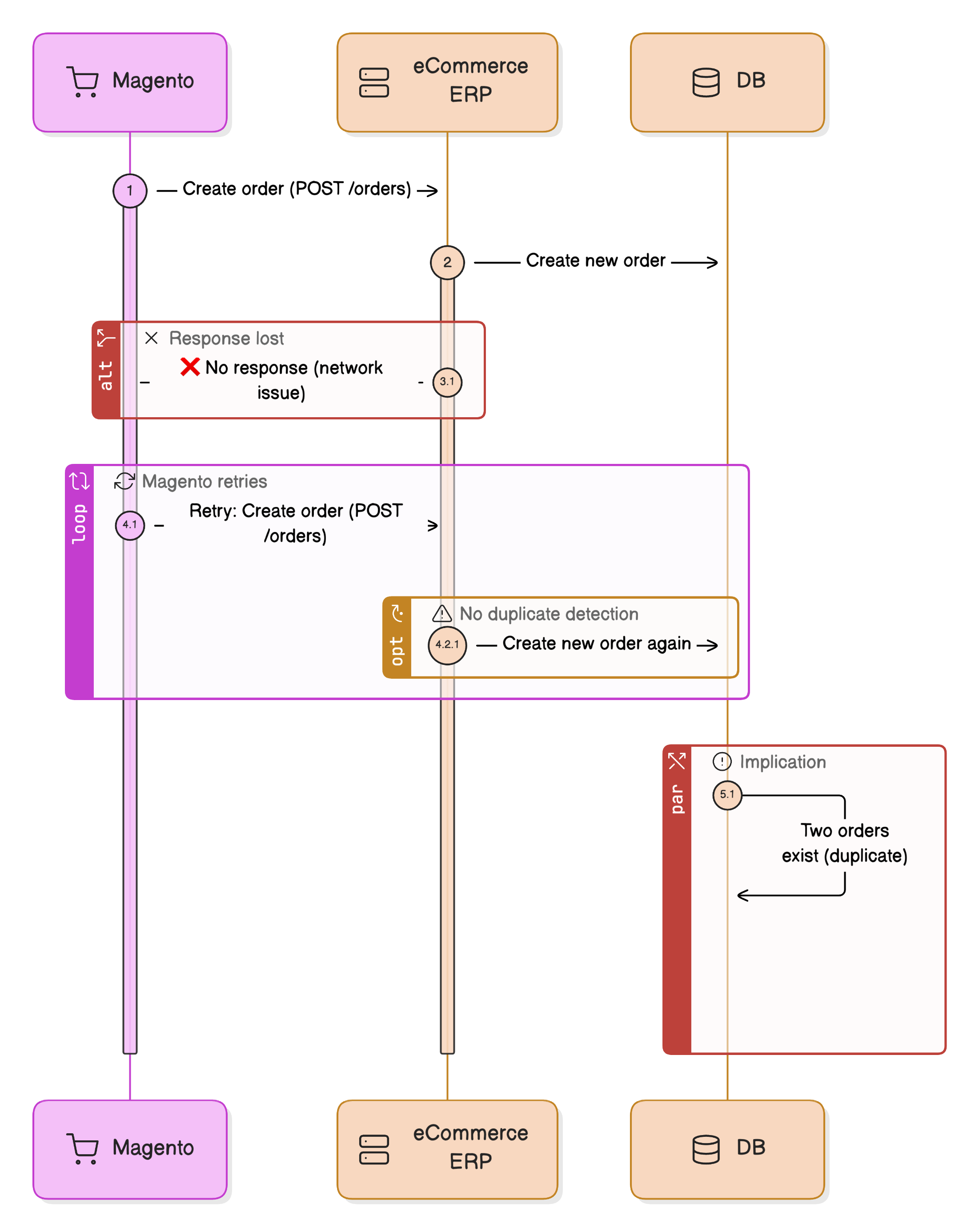
Result:
- Same business order, different internal IDs
- Inventory reserved twice
- Finance sees duplicate revenue
- Manual cleanup required inside ERP
❗ The integration worked perfectly — twice.
No errors. No exceptions. Just silent duplication.
Case #2: Payment captured twice
Context: eCommerce → Payment Provider → Webhook
Endpoint:
POST /payment-confirmedWhat went wrong:
- Payment provider sends webhook
- Your system processes payment
- Temporary DB issue causes
500response - Provider retries webhook (as designed)
- Payment is captured again
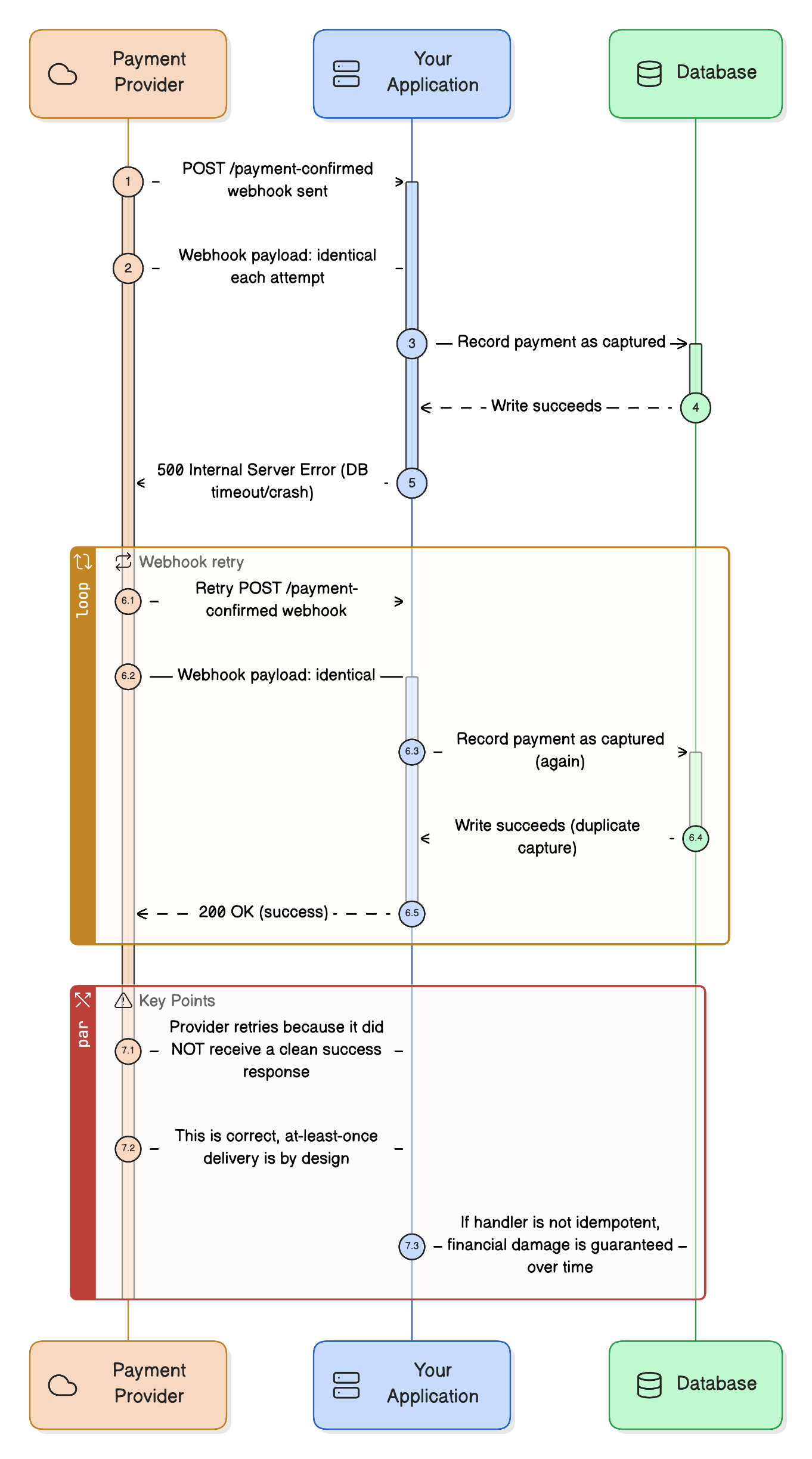
Impact:
- Customer charged twice
- Refunds and chargebacks
- Support tickets
- Trust permanently damaged
Root cause: 👉 Webhook handler was not idempotent.
Case #3: When “at-least-once” events burned the warehouse
Context: ERP → Message Broker → eCommerce (event-driven inventory updates)
The ERP publishes inventory update events. The broker guarantees at-least-once delivery.
Sounds safe.
It isn’t.
The event
{
  "eventId": "evt-739182",
  "sku": "ABC-123",
  "available": 5,
  "timestamp": "2025-01-14T10:22:31Z"
}
Consumer logic:
“When an event arrives — update inventory.”
No event tracking. No idempotency.
What actually happened
- ERP publishes inventory event
- Consumer receives it
- Inventory updates correctly
- Consumer crashes before ACK
- Broker re-delivers the same event
- Inventory update runs again
No error. Same event. Same payload.
The real damage
The inventory update triggered:
- Re-indexing
- Cache invalidation
- Backorder recalculations
- Stock alert notifications
Because the same event was processed twice:
- Customers received duplicate “Back in stock” emails
- Indexers ran unnecessarily
- Storefront slowed down under peak load
Nothing was wrong.
Everything was duplicated.
Why this was dangerous
- No negative stock
- No financial mismatch
- No alerts
Just:
- Extra load
- Confused business users
- Hard-to-explain side effects
This kind of bug survives QA and only shows up in production.
Why retries are unavoidable
Many teams believe:
“We don’t retry requests, so duplicates won’t happen.”
That’s a myth.
Retries come from:
- HTTP clients
- API gateways
- Load balancers
- Message brokers
- Webhook providers
If your integration assumes exactly-once delivery, it is already broken.
What idempotency actually means
Idempotency means:
Processing the same request multiple times produces the same result as processing it once.
Not “almost the same”. Not “should be fine”.
Exactly the same.
How to implement idempotency (real patterns)
1. Idempotency keys
POST /orders
Idempotency-Key: 8f3a9c2e-41f1-4c4b-a9f9-0e12d4c8b111
Server rules:
- Store key + result
- If key already exists → return previous response
- Never re-run business logic
Used by Stripe, PayPal, and every serious payment API.
2. Natural business keys
A very common real-world example is payments and transactions.
When a customer submits a payment, you usually create two entities:
- an Order
- a Transaction
The transaction has a unique transaction number generated by the payment system.
This number already represents a single real-world action: "capture this payment".
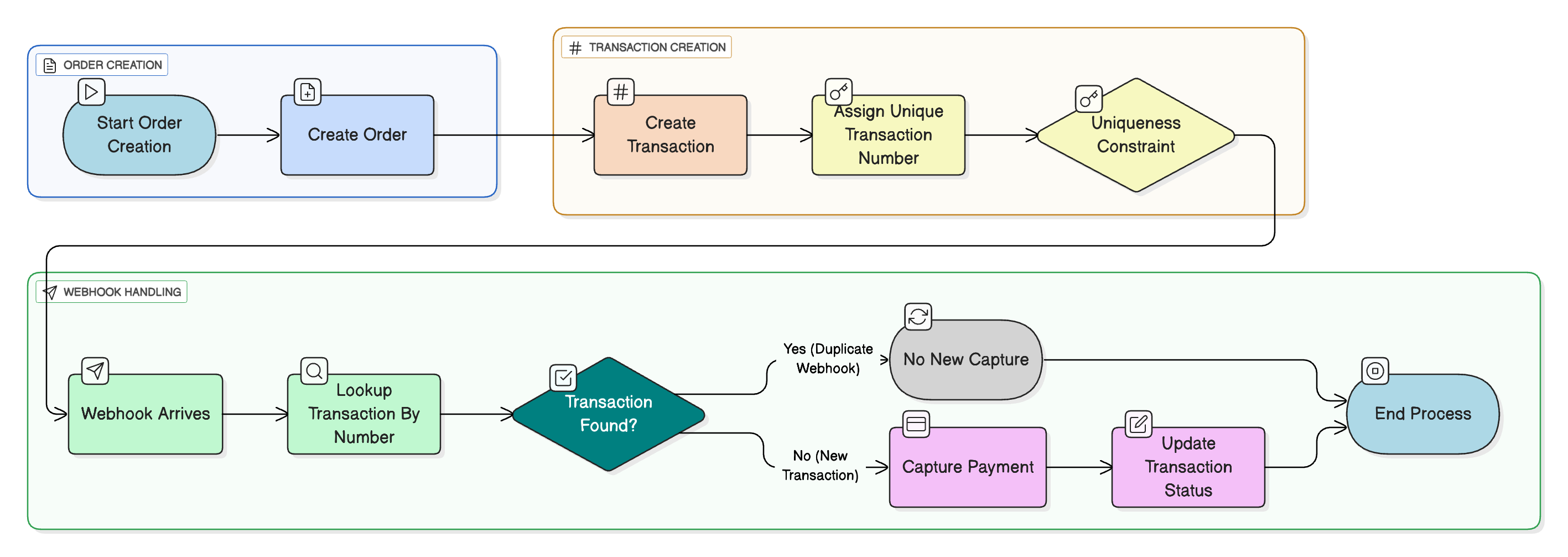
How idempotency works here
- When the transaction is first submitted, it is created with a status like:
initiatedprocessing
- The transaction number is stored and enforced as unique
- Payment webhooks include this transaction number in metadata (most platforms support this)
- If the webhook is delivered again, the system finds the existing transaction
- The handler exits safely without creating or capturing anything again
Result:
- Only one capture is possible
- Duplicate webhooks become harmless replays
- No double charges
Rules
- Use business-generated identifiers (
transactionNumber,externalOrderId,erpDocumentId) - Enforce uniqueness at the database level
- Treat duplicates as replays, not errors
- Return a safe success response
Never rely only on:
“Check if it exists, then insert.”
That logic fails under concurrency.
Two requests can pass the check at the same time. Only the database can arbitrate truth.
Rule of thumb: if a business key represents a real-world transaction, the system must allow it to be completed only once — no matter how many times the request or webhook arrives.
3. Idempotent handlers
This is where most event-driven systems break — not because of bugs, but because of delivery guarantees.
In enterprise systems, message brokers such as Kafka, RabbitMQ, SQS almost always provide at-least-once delivery. This guarantees that a message will be delivered, but it also means the same message can be delivered more than once.
A typical message handler effectively runs like this:
read message
begin database transaction
update business data
commit transaction
acknowledge message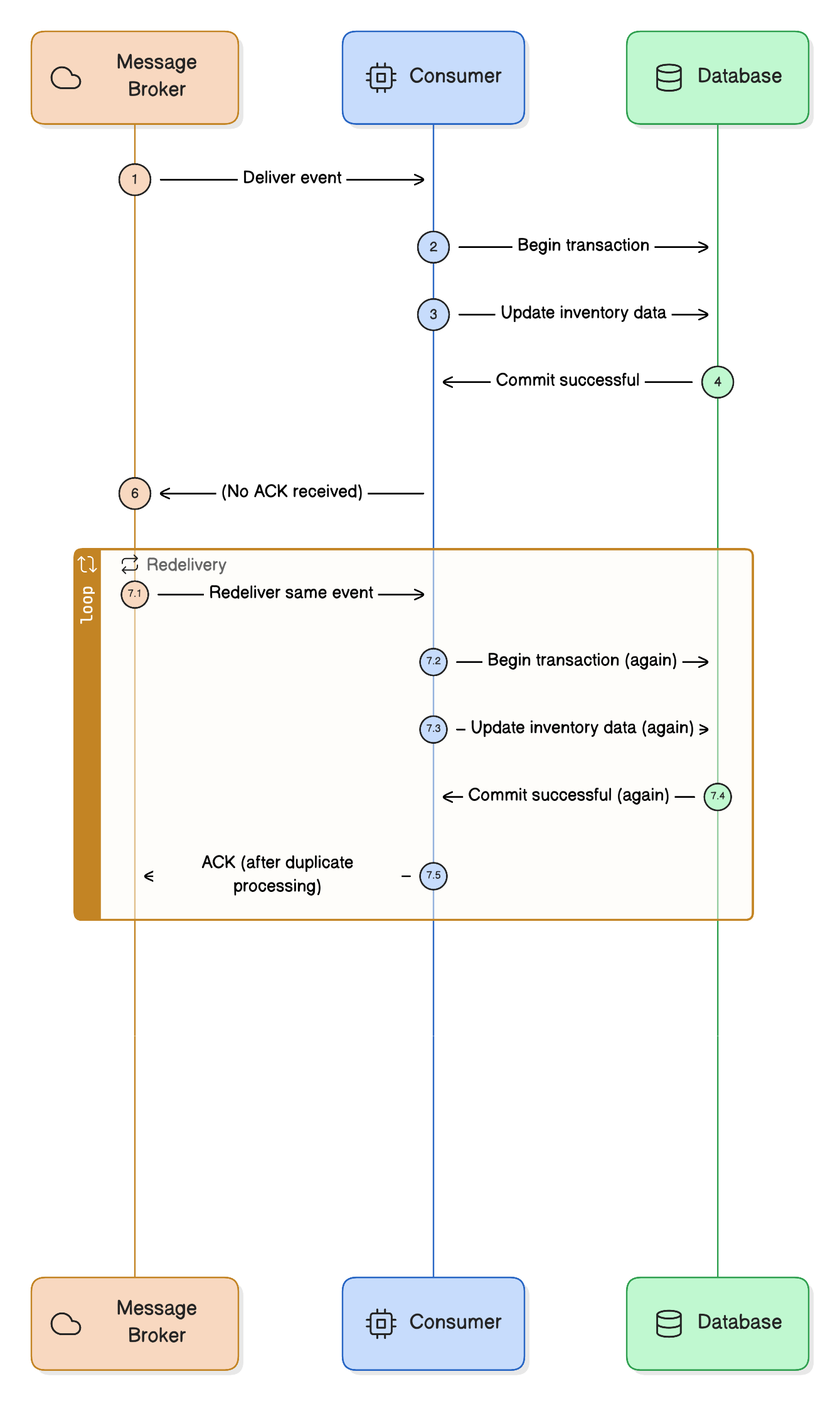
The dangerous gap is between commit and acknowledge.
If the handler crashes, the process restarts, or the broker loses the ACK, the broker will redeliver the same message — even though the database transaction already succeeded.
That’s how the same business logic can execute multiple times for a single message.
Why naive handlers fail
Handlers are often written as state mutations instead of state replacements.
Bad (non-idempotent):
quantity = quantity - 5If this message is delivered twice:
- the database transaction runs twice
- the same business effect is applied twice
- the system slowly drifts into an incorrect state
No exception is thrown. No error is logged.
The system is simply wrong.
What idempotent handlers look like
Good (idempotent):
quantity = 5This handler describes the desired end state, not the transition.
If the message is replayed:
- the database ends up in the same state
- side effects are not multiplied
- the system remains correct
Making handlers idempotent in practice
There are two common strategies:
1. Track processed message IDs
- Store
messageId/eventIdin the database - Enforce uniqueness (unique index or conditional write)
- If the ID already exists → treat the message as a replay and exit safely
This can be implemented:
- in a dedicated
PROCESSED_MESSAGEStable (SQL) - inside the business entity itself (common for NoSQL)
2. Make updates naturally idempotent
- Prefer state replacement over mutation
- Use absolute values instead of deltas
- Store the highest processed event version per aggregate
Rule of thumb: assume every message will be delivered more than once.
If processing the same message twice changes the outcome, the handler is not production-safe.
A rule worth remembering
If your integration cannot safely process the same request twice, it is not production-ready.
Idempotency is not an optimization. It is a safety guarantee.
Key takeaways
- Duplicate requests are normal
- Retries are unavoidable
- Idempotency must be designed intentionally
- Payments, orders, and inventory must be idempotent
- If you ignore this, production will teach you — painfully
In the next article, we’ll talk about retry patterns that don’t destroy systems.
Because retries without idempotency are a loaded gun.
Enjoying this article?
Get more deep dives on integration architecture delivered to your inbox.

Integration Architect
Artemii Karkusha is an integration architect focused on ERP, eCommerce, and high-load system integrations. He writes about integration failures, architectural trade-offs, and performance patterns.
Related Articles
UCP April 2026: Cart, Catalog, and Signals Change Everything
The Universal Commerce Protocol just shipped its biggest release yet: cart management, catalog search, product lookup, and a signals framework for fraud prevention. I broke down 27 new schemas, 5 breaking changes, and the architectural implications for teams building commerce integrations.
Visa VIC vs UCP: Two Competing Visions for Agentic Commerce
Visa published their VIC reference agent — a 5-microservice demo of AI-driven shopping with tokenized payments. I dissected the architecture, compared it to UCP and other open protocols, and found a fundamental design tension: card networks optimize for payment security, open protocols optimize for merchant flexibility.
Polling vs Webhooks: How to Choose the Right Integration Trigger
The polling vs webhooks debate has a clear winner in most integration projects — and it's neither. Learn the real trade-offs, the hybrid pattern that survives production, and a 5-question decision framework for choosing the right trigger strategy.
Came from LinkedIn or X? Follow me there for more quick insights on integration architecture, or subscribe to the newsletter for the full deep dives.